

Pest library · Andrenidae and Halictidae
Ground Bees in Delaware: Identification Before Treatment
Small mounds of soil across a bare lawn in April usually mean solitary mining bees, not a nest of anything aggressive. The species matters, because most ground bees should not be treated at all.
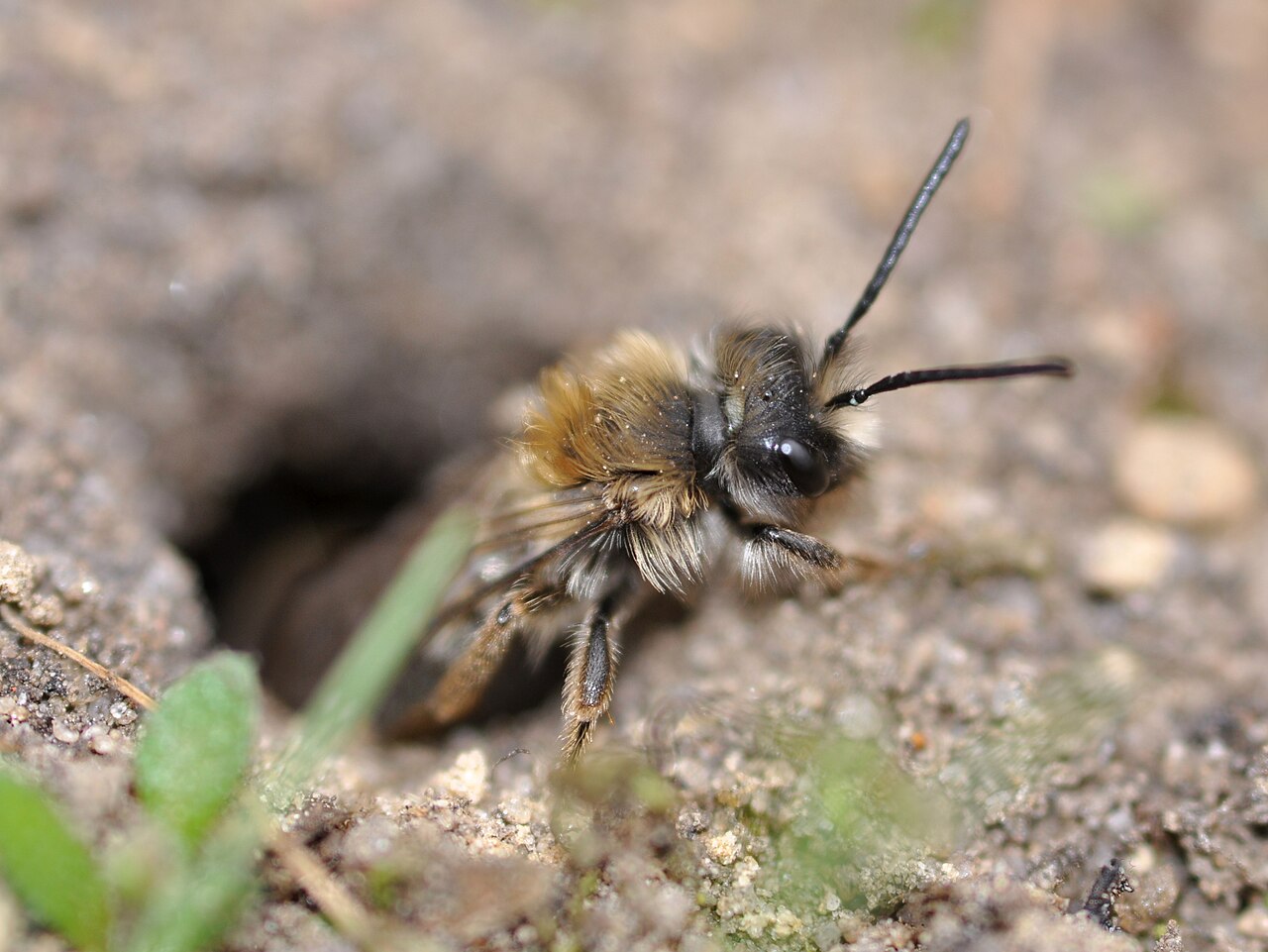
What ground bees look like
"Ground bees" is not one insect. In Delaware the term covers two families of solitary bees: mining bees (Andrenidae, mostly Andrena spp.) and sweat bees (Halictidae, including Halictus and Lasioglossum).
Mining bees run roughly a third to two thirds of an inch, noticeably furry, generally dark brown or black with pale hair bands on the abdomen and dense pollen-carrying hair on the hind legs. They read as small, slightly scruffy honey bees.
Sweat bees are smaller, often under a third of an inch. Some are dull brown with faint striping; others a bright metallic green or bronze that is unmistakable. They earn the name by landing on skin to drink perspiration in hot weather, which alarms people more than it should.
The nests are the clearest sign. Each female digs and provisions her own burrow, so you get a scattering of small conical mounds, each with a single pencil-width hole in the center. Dozens may appear within a few square yards.
An aggregation is not a colony. Solitary bees nesting side by side have no shared nest, no queen to protect and no worker force. There is nothing for them to defend as a group, which is why you can stand in the middle of a hundred burrows and be ignored.
How they get in — and why they usually do not
Ground bees do not enter buildings. They are not looking for food indoors, they do not nest in walls, and a bee inside the house is almost always something else that came through a door or window.
What they want is soil, and they are specific about it:
- Bare or thinly vegetated ground with the surface exposed to sun.
- Well-drained sandy or sandy-loam soil, which describes much of Kent County.
- Dry surface conditions — they avoid wet or heavily irrigated ground.
- South- and west-facing slopes and banks that warm early in spring.
- Thin, worn turf: paths, dog runs, the strip beside a driveway.
Put plainly, ground bees colonize the parts of a lawn that are already struggling. Thick, healthy turf does not attract them, and an aggregation is often a fair signal about compaction or shade in that spot.
What they do
They pollinate, and they do it well. Mining bees are among the earliest active pollinators in the Mid-Atlantic, working maples, willows and fruit trees while honey bee colonies are still building up. For a garden or a berry patch, an aggregation is a benefit rather than a problem.
The sting risk is genuinely low. Males patrol the nesting area and fly at faces but cannot sting at all — they have no sting apparatus. Females can sting and are strikingly reluctant to. There is no nest defense response, so mowing or walking through does not trigger an attack.
Damage to the lawn is cosmetic. The mounds are loose soil that rakes flat or washes away in the first good rain, and the burrows are too small to affect turf health. The situations that make an aggregation a genuine problem are narrow: an allergic member of the household, a nest site under a play area, or a property where any stinging insect near foot traffic is an issue.
Our default position on solitary ground bees is not to treat. They are pollinators, the activity is over in a matter of weeks, and killing an aggregation solves a problem that mostly is not there. We would rather identify the insect correctly and tell you that.
When you see them in Delaware
Mining bees emerge with the spring warm-up, generally late March into April, and are most obvious through April and May. The flight period for a given species runs about four to six weeks. By early summer the adults are gone and the next generation is developing underground, which is why the mounds seem to vanish.
Sweat bees are active over a longer season, spring through late summer, and are the ones landing on arms and necks on humid July afternoons.
The timing is itself diagnostic. Small bees working the soil in April are almost certainly solitary bees. Insects pouring in and out of a single hole in August are almost certainly not.
Ground bees vs yellowjackets
This is the distinction that decides everything. Yellowjackets also nest in the ground — usually in an abandoned rodent burrow or a void under a stump — and they are genuinely defensive, sting repeatedly and will pursue. Telling them apart takes about thirty seconds from a safe distance.
- Number of holes. Solitary bees: many holes, each with its own occupant. Yellowjackets: one hole, everything going in and out of it.
- Traffic. Solitary bees drift in and out unhurriedly. A yellowjacket entrance has fast, steady two-way traffic.
- Body. Bees are hairy and thick-bodied. Yellowjackets are smooth, shiny, sharply banded black and yellow, with a narrow waist.
- Season. Ground bees peak in April and May. Yellowjacket ground nests go unnoticed until July and peak in late August and September.
- Response to you. Ground bees ignore a person standing among them. A disturbed yellowjacket nest responds immediately.
If the description matches the second half of each line, stay away from it and read our page on wasps and yellowjackets. Ground nests are one of the few stinging-insect situations worth treating promptly, particularly near doors, walkways or a mower's path. They often take over old rodent burrows, so a yard with a history of voles or mice is likelier to host one.
Two other common mix-ups
The eastern cicada killer (Sphecius speciosus) alarms more homeowners than anything else here. It is a solitary wasp up to about an inch and a half long, black with yellow markings and rusty wings, digging large burrows in bare sandy ground in July and August to stock with cicadas. Despite the size, males cannot sting and females are not defensive.
Carpenter bees (Xylocopa virginica) get confused with ground bees too, though they nest in wood. Look for a shiny, hairless black abdomen — a bumble bee's is fuzzy — and round half-inch holes drilled into fascia, deck rails and unpainted trim.
How to keep them out
You do not exclude ground bees; you make the ground less appealing. Every measure below changes soil conditions rather than killing anything.
- Overseed and topdress thin, bare patches in fall so there is no exposed soil the following spring.
- Correct the reason the grass is thin — compaction, shade, traffic or drainage — instead of reseeding the same patch every year.
- Water the area. Solitary bees select dry soil, so irrigation through the spring flight period discourages nesting.
- Mulch or plant beds where turf will not hold, particularly on sunny banks and slopes.
- Time the work for late summer or fall, once the adults have finished, rather than during the flight.
None of this is urgent. A spring aggregation resolves itself in a few weeks whether or not you act, and the same site may or may not be used next year.
How we treat ground bees
The first step is identification, and it is often the last step too.
Inspect and identify
We look at the nest structure, the flight pattern and the insect itself. Multiple small mounds with individual entrances, fuzzy bees, spring timing — that is a solitary bee aggregation, and we will say so and recommend leaving it alone. Where it sits awkwardly we will discuss changes to the site instead of treatment.
When treatment is warranted
A single entrance with heavy wasp traffic is a different situation. Ground-nesting yellowjackets close to a doorway, patio, play area or mowing line get targeted treatment applied directly to the nest entrance at low light when the colony is inside, with a return visit to confirm activity has stopped. That is precise work aimed at one nest, not a broadcast application across a lawn.
Household allergy history changes the calculus and we take it seriously. Otherwise the position is straightforward: identify first, treat only what warrants it. Stinging-insect work sits alongside our general pest control service, so if you are unsure what is in the yard, request an inspection before anyone sprays anything.
Ground Bees FAQs
Are ground bees aggressive?
Solitary ground bees are not. Males cannot sting at all, females sting only if handled or trapped against skin, and there is no colony defense response because each female has her own separate burrow. You can usually stand in the middle of an aggregation without incident.
Should I kill ground bees in my lawn?
In most cases no. Mining bees and sweat bees are important early-season pollinators, they do no real damage to turf, and the adults are gone within a few weeks. Treatment is generally reserved for ground-nesting yellowjackets or for a household with a serious sting allergy.
How do I tell ground bees from yellowjackets?
Count the holes and watch the traffic. Solitary bees produce many small mounds, each with one entrance and unhurried comings and goings. A ground yellowjacket nest has a single hole with fast, constant two-way traffic, and the insects are smooth and shiny rather than furry.
What are the small dirt mounds in my yard in spring?
Small conical mounds with a pencil-width hole in the center, appearing across bare or thin turf in April, are almost always mining bee burrows. Each mound is one female's nest. They flatten with the first rain and the bees are finished for the year by early summer.
What is the giant wasp digging holes in my lawn in July?
Most likely the eastern cicada killer, a solitary wasp up to about an inch and a half long with yellow markings and rusty wings. Despite the size it is not defensive, males cannot sting, and it hunts cicadas rather than bothering people.
How long do ground bees stay around?
The adult flight period for a given mining bee species runs roughly four to six weeks, typically from late March or April into May. After that the adults die off and the next generation develops underground until the following spring.
Do ground bees damage grass?
Not meaningfully. The burrows are narrow and shallow and the loose soil mounds rake flat or wash away in a rain. If anything, an aggregation is a sign the turf in that spot was already thin, which is the underlying issue worth addressing.
Where we treat
Ground Bees control across Delaware
- Claymont, DE
- Hockessin, DE
- Wilmington, DE
- Newark, DE
- New Castle, DE
- Bear, DE
- Delaware City, DE
- Odessa, DE
- Middletown, DE
- Townsend, DE
- Smyrna, DE
- Clayton, DE
- Kenton, DE
- Cheswold, DE
- Hartly, DE
- Little Creek, DE
- Dover, DE
- Wyoming, DE
- Camden, DE
- Marydel, DE
- Magnolia, DE
- Viola, DE
- Frederica, DE
- Felton, DE
- Harrington, DE
- Milford, DE
- Houston, DE
- Lincoln, DE
- Greenwood, DE
- Ellendale, DE
- Bridgeville, DE
- Seaford, DE
- Bethel, DE
- Laurel, DE
- Delmar, DE
Get on the schedule
Dealing with ground bees?
Send a photo and a few details. Correct identification is free and it changes the treatment.