
Pest library · Culicidae
Mosquito Control in Delaware
Delaware yards deal with container-breeding house and tiger mosquitoes, plus salt marsh mosquitoes that fly inland off the bay. Control starts with finding the water.
What mosquitoes look like
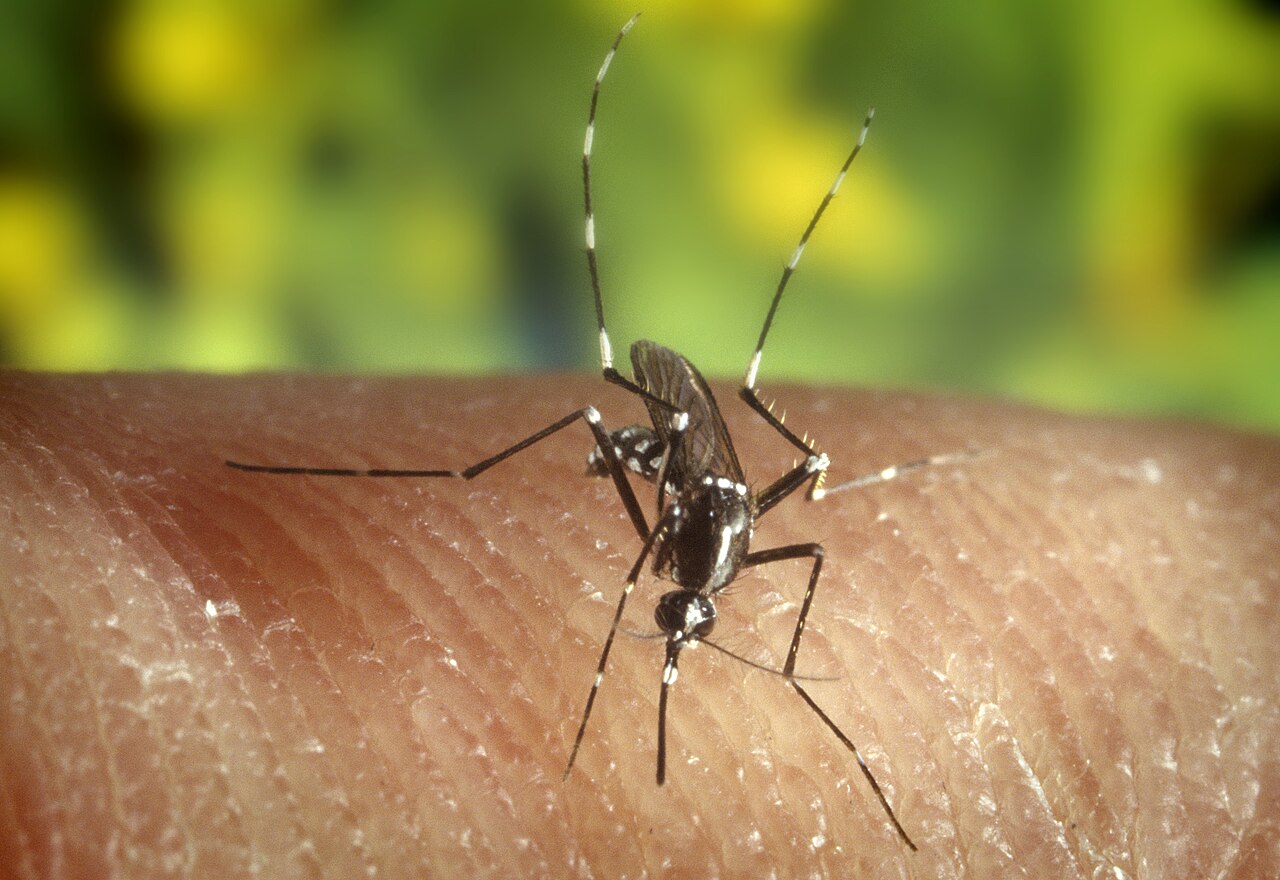
Mosquitoes are small, long-legged flies with a slender body, one pair of narrow scaled wings and a forward-projecting proboscis. Adults run an eighth to a quarter of an inch. Only females bite; both sexes feed on nectar, and the blood meal is protein for egg development. Males have bushy antennae and hover in loose columns at dusk without touching anyone.
Three species account for most complaints in this part of Delaware.
- Northern house mosquito (Culex pipiens) - dull brown, unmarked, medium sized. Bites at dusk and after dark, often indoors. Breeds in stagnant, organically rich water: clogged gutters, buckets, tarps, catch basins.
- Asian tiger mosquito (Aedes albopictus) - small, glossy black with sharp white leg banding and a single white stripe down the thorax. Bites in daylight, low, usually around ankles. Breeds in containers down to a bottle cap of water.
- Eastern salt marsh mosquito (Aedes sollicitans) - larger, brownish with pale banded legs. A strong flier that moves well inland from tidal marsh. Bites hard at dusk and on overcast days, and arrives in numbers.
How they get in
Mosquitoes do not infest a house the way roaches or mice do. They come in through the doors you use, torn screens, a gap at a window air conditioner, or a garage left open through the evening. Once inside, Culex will rest in a dark closet or basement corner and feed at night.
The more useful question is where they were produced. With one exception, most of the mosquitoes biting you came from your yard or a neighboring one. They need standing water for about a week to complete development, and very little of it.
- Clogged gutters and downspout extensions holding a film of leaf-packed water.
- Corrugated drain pipe, which almost never drains completely.
- Plant saucers, tarps, wheelbarrows, toys, trash can lids, recycling bins, boat covers, and birdbaths or pet bowls left more than a few days.
- Tree holes, blocked French drains, and standing water in roadside and field ditches.
- Unmaintained pools, ponds without fish or movement, and rain barrels without a screened lid.
The exception matters. Eastern salt marsh mosquitoes lay eggs on damp marsh soil, and broods hatch when a high tide or heavy rain floods the pans. They then travel in miles rather than yards, so a property near the Delaware Bay marshes east of Smyrna or Frederica can be immaculate and still get hit after a flood tide.
What they do
For most people, most of the time, mosquitoes are a nuisance that takes a yard away in the evening. The bite reaction is a histamine response to saliva. It itches, it swells, some people react more strongly than others, and scratching a bite open is the most common actual complication.
The disease question deserves a straight answer rather than dismissal or alarm. West Nile virus is the mosquito-borne illness that genuinely circulates in Delaware, carried mainly by Culex species that feed on birds and then on people. Most people who are infected never develop symptoms. A minority get a flu-like illness. A small fraction, mostly older adults and people with weakened immune systems, develop serious neurologic illness. Eastern equine encephalitis is detected in the region occasionally; human cases are rare, though serious when they occur.
That is low probability with real consequence, which is why reducing exposure beats either ignoring mosquitoes or treating every bite as an emergency. The salt marsh and tiger mosquitoes that bite hardest are not the main West Nile carriers here.
Dog heartworm is transmitted by mosquitoes and is a real concern for pets across the Mid-Atlantic. Preventive medication from a veterinarian is the control that matters. Yard treatment reduces bites but is not a substitute.
When you see them in Delaware
The season generally opens with the April warm-up, once overwintering females become active and standing water stays warm enough for larvae to develop. Activity builds through May and June.
July and August are the peak: humid nights, afternoon thunderstorms refilling every container in the yard, and a cycle from egg to biting adult that can run in about a week. Salt marsh broods spike after high tides flood the marsh pans, so the worst nights near the bay often follow the new and full moon tides.
September and October stay active, and the first cool snaps do not end it. Biting continues on warm afternoons until sustained cold arrives, typically with the hard frosts around November. Culex females overwinter as adults in crawlspaces, sheds and basements. Aedes overwinter as drought-resistant eggs cemented inside containers, which is why scrubbing a bucket out in October is worth doing.
Mosquitoes vs crane flies and midges
Two harmless insects get swatted on sight in Delaware every summer under the impression that they are mosquitoes, and one of them carries a nickname that makes it worse.
- Crane flies - the long-legged, inch-plus insects that bumble around porch lights and hang on screens. They look like enormous mosquitoes and are sometimes called mosquito hawks. They do not bite, have no piercing proboscis, and do not eat mosquitoes.
- Non-biting midges - small, mosquito-shaped, and responsible for the swarming column over water at dusk. Midges hold their front legs raised at rest and lack the long proboscis. They emerge from ponds and ditches in large numbers without ever biting anyone.
- Fungus gnats - much smaller, weak fliers, found indoors around overwatered houseplants. Also non-biting.
The practical difference is straightforward. If it lands quietly, angles its body down, and you feel nothing until later, that is a mosquito. If it is large, clumsy and bouncing off a light fixture, it is a crane fly. Identifying correctly matters, because treating a yard for a midge hatch off a neighboring pond does nothing.
How to keep them out
Source reduction does more than anything else available. Once a week, walk the property and empty, drain, cover or scrub anything holding water. A container missed for two weeks in July is a container that produced mosquitoes.
- Clean gutters twice a year and check that downspout extensions and corrugated pipe actually drain.
- Turn over, drill drainage holes in, or store anything that collects water: saucers, buckets, toys, tarps, planters.
- Change birdbath and pet water weekly and scrub the sides, because Aedes eggs are cemented above the water line and survive a dump.
- Screen rain barrels and keep water features moving or stocked; a pond with fish produces very few mosquitoes.
- Repair window and door screens, and check the seal around window air conditioners and crawlspace vents.
Reducing harborage helps as well. Adults rest through the day in shade, dense low vegetation and damp leaf litter. Thinning ivy on the shaded side of a house, keeping grass cut and clearing leaf piles all cut the habitat that lets a population sit next to your patio. The same work reduces tick habitat, since both use the same humid edges.
Personal measures still matter for salt marsh mosquitoes you cannot control at the source: repellent, long sleeves at dusk, and a fan on a porch, since mosquitoes avoid moving air.
How we treat mosquitoes
We start with a property survey rather than a sprayer: walking the lot and its edges, recording every water source, checking for larvae, and identifying which species are present, because Culex, Aedes and salt marsh mosquitoes each call for a different emphasis.
Source reduction and larval control come first. Water that can be eliminated is eliminated. Water that has to stay - a catch basin, a low ditch, a stock tank, a run of corrugated drain - is treated with a larvicide applied to the water itself, which stops development before adults emerge. Killing larvae in one catch basin removes more biting mosquitoes than a lot of adult spraying does.
Adult control and monitoring
Adult applications target resting sites rather than broadcasting over open lawn: the undersides of dense shrub foliage, shaded ivy, fence lines and the low vegetation where mosquitoes sit out the day. Treatments are timed to the season and repeated on a cycle through summer, because adults keep flying in from off the property. We avoid treating flowering plants while pollinators are working them.
Then we monitor and adjust: checking whether biting pressure is resident or arriving from elsewhere, revisiting sources after storms, and changing the program when the species mix shifts. Details of the seasonal program are on our mosquito control page. The same shaded yard edges usually hold ticks, so the two are often run together. To have a property surveyed, contact us.
Mosquitoes FAQs
Why are mosquitoes so bad in my yard?
Almost always because water is standing somewhere close by. Clogged gutters, corrugated drain pipe, plant saucers, tarps and neglected birdbaths are the usual sources, and a container the size of a bottle cap is enough for Asian tiger mosquitoes. Shaded, damp vegetation also gives adults somewhere to rest through the day.
Do mosquitoes in Delaware carry West Nile virus?
Yes, West Nile virus circulates in Delaware and is carried mainly by Culex species. Most people who are infected never develop symptoms, and a minority get a flu-like illness. Serious neurologic illness happens in a small fraction of cases, mostly in older adults and people with weakened immune systems.
How long does it take a mosquito to develop?
In warm summer conditions, egg to biting adult can take about a week. That is why weekly emptying of containers works: it interrupts the cycle before larvae mature. In cooler spring weather the same cycle runs considerably longer.
What is the difference between a crane fly and a mosquito?
Crane flies are much larger, with very long legs, and they bumble around porch lights and screens. They have no piercing mouthparts, do not bite, and despite the mosquito hawk nickname the adults do not eat mosquitoes. A mosquito is small, lands quietly, and has a visible forward-pointing proboscis.
Where do mosquitoes go in the winter in Delaware?
Culex females overwinter as adults in sheltered places such as crawlspaces, sheds, culverts and basements. Aedes species overwinter as drought-resistant eggs stuck to the inside walls of containers, which hatch when the container refills in spring. Emptying and scrubbing containers in fall removes those eggs.
Do bug zappers control mosquitoes?
Not meaningfully. Zappers kill mostly non-target insects such as moths and beetles, and mosquitoes are drawn to carbon dioxide and body heat rather than ultraviolet light. Source reduction, larval control and targeted treatment of resting sites do far more.
Can salt marsh mosquitoes reach my house from the bay?
Yes. Eastern salt marsh mosquitoes are strong fliers and travel miles inland from tidal marsh, so properties well away from the water can be affected after a flood tide. Because they are not produced on your lot, yard source reduction helps less with this species and personal protection matters more.
Where we treat
Mosquitoes control across Delaware
- Claymont, DE
- Hockessin, DE
- Wilmington, DE
- Newark, DE
- New Castle, DE
- Bear, DE
- Delaware City, DE
- Odessa, DE
- Middletown, DE
- Townsend, DE
- Smyrna, DE
- Clayton, DE
- Kenton, DE
- Cheswold, DE
- Hartly, DE
- Little Creek, DE
- Dover, DE
- Wyoming, DE
- Camden, DE
- Marydel, DE
- Magnolia, DE
- Viola, DE
- Frederica, DE
- Felton, DE
- Harrington, DE
- Milford, DE
- Houston, DE
- Lincoln, DE
- Greenwood, DE
- Ellendale, DE
- Bridgeville, DE
- Seaford, DE
- Bethel, DE
- Laurel, DE
- Delmar, DE
Get on the schedule
Dealing with mosquitoes?
Send a photo and a few details. Correct identification is free and it changes the treatment.