

Pest library · Lepisma saccharina
Silverfish Control in Delaware
Silverfish are a moisture problem wearing an insect costume. Correct the humidity in a basement, crawlspace or bathroom and the population usually collapses on its own.
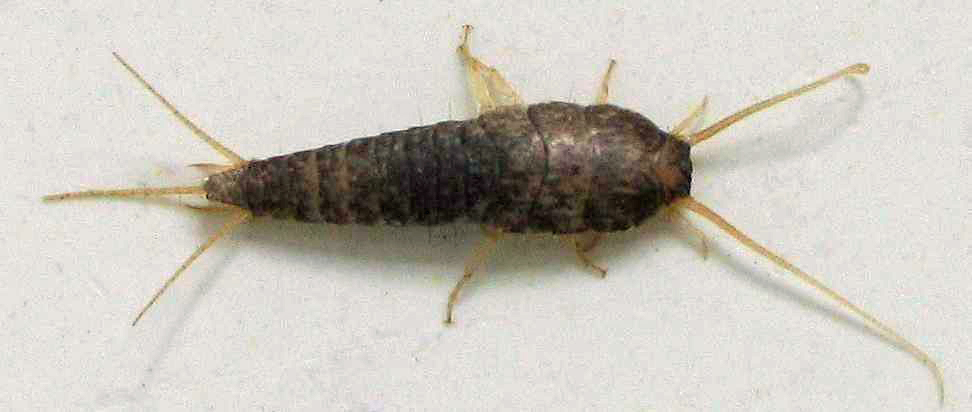
What silverfish look like
Silverfish are wingless, teardrop-shaped insects about half an inch long, tapering from a broad head end to a narrow tail. The body is covered in fine metallic scales, which give the silver-gray sheen behind the name, and those scales rub off easily, so one caught under a glass often looks duller than expected. Three long bristles trail from the rear and two long antennae sweep forward, so the insect appears to have a tail at both ends.
They move in quick, side-to-side, fish-like darts and then stop dead. They cannot climb smooth vertical surfaces, which is why they turn up stranded in a bathtub, a sink or a glass jar. They fell in and could not get out.
The firebrat, a close relative, lives in the same houses and gets called a silverfish constantly. It is mottled gray and brown rather than silver, and it prefers heat: attics in August, boiler rooms, the cavity around a furnace flue. Habits and control are the same for both. Both keep molting for life and can live several years, which is why a population builds slowly and then feels like it has always been there.
How they get in
Silverfish rarely march in from the yard. They live outdoors under bark and stones, but the ones inside a house usually arrived in something, found conditions they liked and stayed.
- Cardboard boxes moved in from a damp garage, shed or storage unit. Corrugated cardboard is food and harborage at once.
- Stacks of stored paper, old books and newspapers, especially anything kept on a basement floor.
- Bags of flour, cereal and dry pet food carried up from a storeroom.
- Wall voids and the gap behind baseboards in older houses, which let them travel between rooms unseen.
- Plumbing penetrations under sinks and behind tubs, where a slow leak keeps a small area permanently damp.
What holds them is humidity. Silverfish need high relative humidity to survive, and they seek out the dampest microclimates in a building: an unconditioned basement, a bathroom with no working exhaust fan, a crawlspace over bare soil, attic sheathing that sweats through a Delaware August. The older brick and timber housing around Odessa and Dover often has exactly those conditions in a cellar. Newer slab subdivisions around Middletown are not exempt either.
What they do
Silverfish do not bite, do not sting, carry no disease and do no damage to structural wood. They are a genuine nuisance and a genuine problem for stored paper and fabric, and nothing beyond that. We are not going to dress it up.
They feed on carbohydrates, particularly starches and sugars, and what they prefer explains the damage they cause.
- Paper and books. They graze the surface, leaving etched patches and ragged notches at the edges, and are especially fond of the starchy sizing in older paper and the glue in bindings and spine linings.
- Wallpaper. The paste is the attraction. Damage shows as thin irregular tracks where paper has been grazed from behind, usually at seams and the top edge.
- Starched and sized fabric. Cotton and linen carrying starch, plus anything with food or perspiration residue. Damage is surface grazing and small irregular holes.
- Photographs, labels, envelope gum and packaging and anything else built with a starch-based adhesive.
- Dry pantry goods such as flour, cereal and pet food, which they contaminate more than they consume.
They also leave yellowish stains and loose scales on what they visit, and their droppings are tiny black specks like ground pepper. Damage accumulates slowly, so a silverfish problem is rarely urgent. The box of documents nobody has opened in years is where the cost eventually shows up.
When you see them in Delaware
Silverfish are active year round indoors, but reports cluster through the humid stretch from June into September, when outdoor dew points stay high and basements and crawlspaces run damp for weeks at a time. That is when a slow-growing population finally becomes visible.
A second cluster comes in late fall and winter, and that one is a heating artifact. Once the furnace runs, warm dry air pushes insects out of wall voids toward the few places still holding moisture: bathrooms, kitchen sinks, laundry rooms. People start finding silverfish in the tub in December and assume something new has arrived. It has not arrived, it has relocated.
Firebrats follow heat instead of season and are most obvious in the hottest parts of a house, meaning attics at midsummer and mechanical rooms all year.
Silverfish vs house centipedes
The confusion is fair. Both are fast, both come out at night, both live in damp basements and bathrooms, and both make people jump. They are not related, and they mean different things.
- Legs. Silverfish have six short legs tucked under a scaled body. A house centipede has fifteen pairs of long banded legs held out wide. If you can see the legs from across the room, it is a centipede.
- Shape and color. Silverfish are silver-gray, smooth and teardrop-shaped. House centipedes are yellowish-gray with three dark stripes down the back and a flattened, leggy outline.
- Motion. Silverfish dart in short bursts, wriggling side to side. Centipedes run in a straight, startlingly fast line and then freeze in the open.
- Diet. Silverfish eat starch, paper and glue. Centipedes eat other insects, silverfish included.
That last line is the useful one. House centipedes are predators, and a house with a lot of them usually has a prey population supporting them. Where we find both, silverfish are often part of what the centipedes are living on, and drying the building out reduces both at the same time.
How to keep them out
Silverfish control is humidity control. Every other measure is secondary to it.
- Run a dehumidifier in basements and finished lower levels through the humid months. Holding a space near or below fifty percent relative humidity makes it unsuitable for silverfish.
- Vent bathrooms and clothes dryers to the outside, not into an attic or crawlspace, and run the bathroom fan during and after showers.
- Lay a sealed vapor barrier over bare crawlspace soil and correct standing water under the house. In most crawlspace homes this is the biggest change available.
- Fix slow leaks under sinks, behind toilets and at hose bibs. A permanently damp cabinet floor supports a population on its own.
- Move stored paper and books off concrete floors and into sealed bins instead of cardboard. Cardboard in a damp basement is a silverfish nursery.
- Grade soil away from the foundation and run downspouts clear of it so the perimeter dries between rains.
If you only do one thing, dehumidify. Silverfish in a dry building desiccate and starve. Silverfish in a damp one will outlast any amount of spraying.
How we treat silverfish
We inspect first, with a moisture meter and a look at everywhere that stays damp: crawlspace, basement perimeter, under-sink cabinets, the wall behind a tub surround, and the attic if a bathroom fan discharges there. Identification matters too, because firebrats point at a heat source rather than a damp one.
Where treatment is warranted we place it in harborage rather than across open surfaces: cracks and crevices, baseboard voids, sill plates, plumbing penetrations, and the joint where a basement floor meets the wall. Dusts hold up well in dry voids and are usually the better choice there. Sticky monitors go down in the same areas, to confirm where the population sits and to measure whether numbers are falling.
Then we follow up, because silverfish do not crash overnight. Eggs sit in cracks and hatch on their own schedule, and a population that took two years to build takes several weeks to draw down. We recheck monitors, adjust placement, and confirm the moisture correction is holding.
We will also tell you when the answer is not pesticide. In most silverfish homes the real fix is a dehumidifier, a vapor barrier or a working bathroom fan, and treatment only shortens the wait. This work usually rides along with general pest control, which covers the same damp harborage that supports centipedes and cockroaches. Get an inspection scheduled to have the moisture side looked at.
Silverfish FAQs
Are silverfish harmful to humans?
No. They do not bite or sting, they carry no disease, and they cause no structural damage. The harm is limited to paper, book bindings, wallpaper paste, starched fabric and dry pantry goods.
What attracts silverfish to a house?
Humidity first, food second. They need consistently damp air and gravitate to basements, bathrooms, crawlspaces and attics that sweat. Stored cardboard, paper, books and dry goods then give them somewhere to feed.
Do silverfish eat clothes?
They graze on cotton and linen that carries starch, sizing, food residue or perspiration, leaving surface damage and small irregular holes. They do not eat wool the way clothes moths do. Clean, unstarched clothing stored somewhere dry is rarely touched.
How do I get rid of silverfish permanently?
Dry the space out. A dehumidifier, a vapor barrier over crawlspace soil and a bathroom fan vented outside remove the conditions they depend on. Treatment into cracks and voids speeds things up, but without the moisture correction the population returns.
Why do I find silverfish in the bathtub?
They cannot climb smooth vertical surfaces. A silverfish that wanders into a tub or sink looking for moisture is trapped there and is still sitting in it the next morning. It did not come up the drain.
Are silverfish and firebrats the same thing?
They are close relatives with the same habits and the same control. Silverfish are uniformly silver-gray and prefer cool damp spaces, while firebrats are mottled brown and gray and prefer heat, so they show up in attics, boiler rooms and around furnace flues.
How long do silverfish live?
Several years, which is unusual for a household insect. They keep molting after reaching adult size and reproduce over a long period. That long life is why populations build slowly and why control takes several weeks rather than days.
Where we treat
Silverfish control across Delaware
- Claymont, DE
- Hockessin, DE
- Wilmington, DE
- Newark, DE
- New Castle, DE
- Bear, DE
- Delaware City, DE
- Odessa, DE
- Middletown, DE
- Townsend, DE
- Smyrna, DE
- Clayton, DE
- Kenton, DE
- Cheswold, DE
- Hartly, DE
- Little Creek, DE
- Dover, DE
- Wyoming, DE
- Camden, DE
- Marydel, DE
- Magnolia, DE
- Viola, DE
- Frederica, DE
- Felton, DE
- Harrington, DE
- Milford, DE
- Houston, DE
- Lincoln, DE
- Greenwood, DE
- Ellendale, DE
- Bridgeville, DE
- Seaford, DE
- Bethel, DE
- Laurel, DE
- Delmar, DE
Get on the schedule
Dealing with silverfish?
Send a photo and a few details. Correct identification is free and it changes the treatment.