

Pest library · Reticulitermes flavipes
Termite Control in Delaware
Eastern subterranean termites are Delaware's structural pest. They live in the soil, travel up through mud tubes, and eat wood from the inside where nothing shows on the surface.
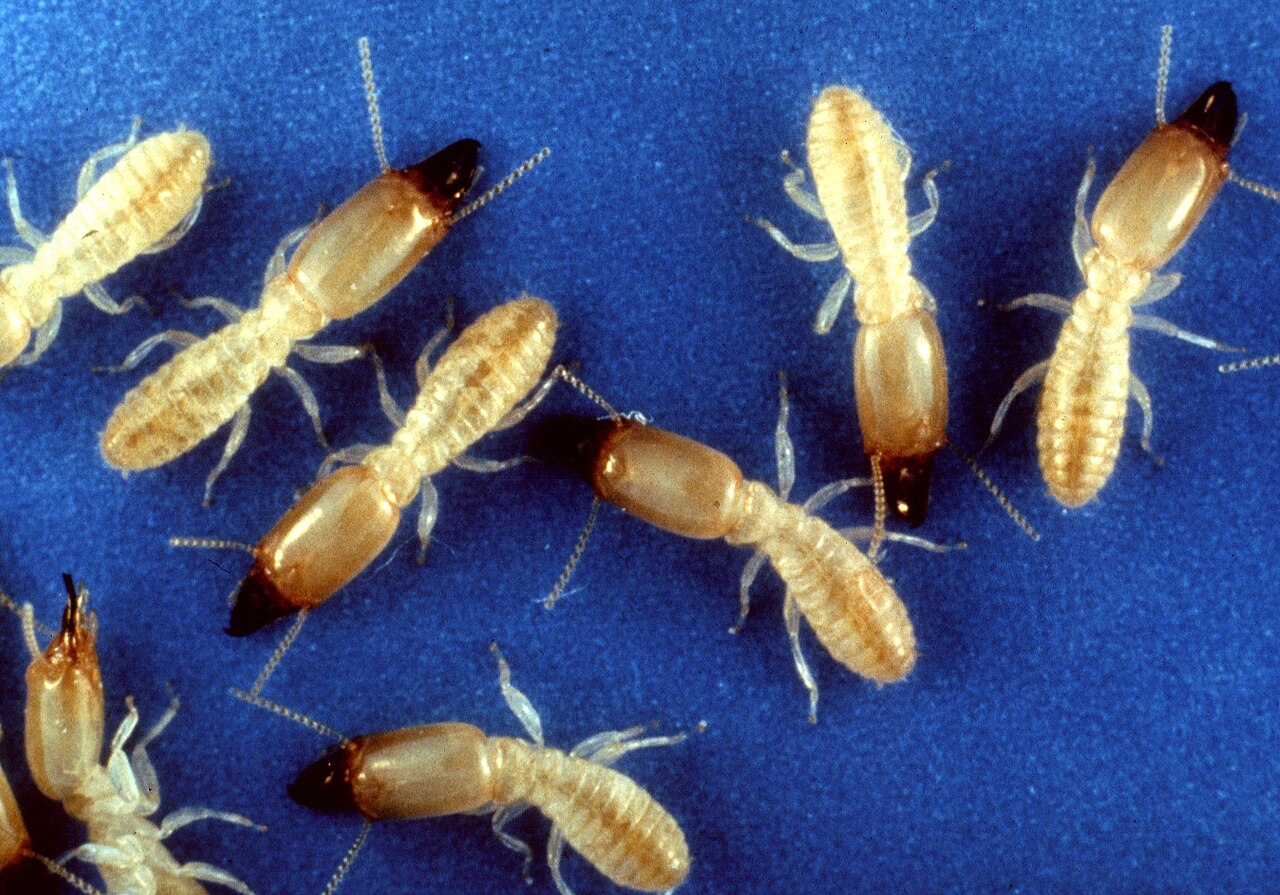
What termites look like
Eastern subterranean termites, Reticulitermes flavipes, live in three castes, and homeowners usually see only one. Workers do the damage: an eighth of an inch long, creamy white, soft-bodied and blind. Break open a mud tube and they scatter back into the dark within seconds.
Soldiers share the pale body but carry a large rectangular amber head with dark, forward-facing mandibles. They do not chew wood; they plug breaches in the tube system, which is why they are often what you see first at a break.
Swarmers and shed wings
Swarmers, or alates, are the reproductive caste and the ones that get noticed: dark brown to nearly black, about three eighths of an inch including the wings, with four smoky wings of equal length extending past the body. The wings shed easily, so the first evidence in most homes is a scatter of identical detached wings on a sill.
- Mud tubes - pencil-width earthen shelter tubes up foundation walls, crawlspace piers and floor joists.
- Blistered or wavy trim - paint that looks rippled over baseboard, casing or sill.
- Hollow-sounding wood - a screwdriver tip pushes straight through into open gallery.
- Soil in the galleries - termite tunnels follow the softer spring grain and pack with mud, unlike the clean galleries carpenter ants leave.
How they get in
The colony is not in your house. It is in the soil nearby, and the house is the largest piece of cellulose in reach. Where foraging workers find a route to wood, they build tubes and feed. Entry comes down to soil contact and moisture.
In the newer slab-on-grade subdivisions around Middletown, the usual routes are the expansion joint where slab meets foundation wall, plumbing and conduit penetrations, the bath trap void under a tub, and settlement cracks. A gap the thickness of a dime is enough.
In older crawlspace and pier construction, common through Camden and Wyoming, they work up piers and walls onto sill plates, band joists and subfloor. Low clearance, damp soil and leftover construction scrap shorten the trip and hide the evidence.
- Wood-to-soil contact: deck posts, stair stringers, fence rails against siding, form boards never pulled after the pour.
- Mulch or soil graded over the top of the foundation, burying the inspection strip.
- Downspouts discharging at the foundation, a flat or reverse grade, a dripping hose bib keeping one corner permanently damp.
- Firewood, lumber and cardboard stacked against the house or stored on a garage or crawlspace floor.
What they do
Termites eat cellulose: framing, subfloor, sheathing, trim, the paper facing on batt insulation, cardboard and stored paper. They work inside the member and leave the outer shell intact, so a joist can be substantially gone and still look sound from below.
The damage is slow. A colony does not take a house down in a season, and anyone selling that urgency is selling something. It accumulates quietly for years in the places nobody looks: the band joist behind insulation, the sill plate at a slab-to-wall joint, framing around a slow shower pan leak. By the time a floor feels soft, the fix is carpentry as well as treatment.
Termites are not a health risk. They do not bite people, carry no disease and do not contaminate food. The entire problem is structural, which is also why it tends to be found late.
When you see them in Delaware
The colony is active year-round. It sits below the frost line in winter, and in a heated house over a warm crawlspace, feeding never fully stops. What changes with the season is what you can see.
Swarming is the visible event. In Delaware, eastern subterranean termites typically swarm from March into May, and they fly in daylight - usually a warm, still, humid midday a day or two after rain. A swarm indoors means the colony is already inside or under the structure. A swarm outdoors means one is nearby.
Mud tubes are easiest to spot from spring through fall, when a broken tube gets repaired within days. That is the simplest field test there is. Smaller secondary swarms sometimes occur in fall. After the first hard frosts, usually around November, surface activity drops and the colony retreats deeper, but the tubes and the damage stay where they were.
Termite swarmers vs flying ants
This is the most common misidentification we deal with, and it matters: one means a wood-destroying insect, the other usually does not. Both swarm in spring, both are dark and winged, both end up dead on the same sill. Three features separate them, and a phone camera is enough to check them.
- Waist - a termite swarmer is broad and straight-sided, with no pinch between thorax and abdomen. An ant has an obvious narrow waist.
- Antennae - termite antennae are straight, like a string of tiny beads. Ant antennae are elbowed, with a distinct bend partway along.
- Wings - a termite has four wings of equal length, longer than its body, that detach at a touch. An ant's front wings are longer than the rear pair and stay attached.
Color is not reliable, since both can be dark. If the wings are all the same size and come off in your fingers, treat it as termites until proven otherwise. Winged carpenter ants swarm in the same weeks and are also wood-associated, but they excavate galleries for nesting rather than eating the wood. Tape a few specimens to an index card; a vacuumed sample rarely identifies.
How to keep them out
Prevention will not stop a foraging colony from finding a house, and we would rather say that plainly. What it does is remove the easy routes, cut the moisture that makes a structure attractive, and keep evidence visible so a problem is caught early rather than in its fifth year. That is the point of an annual termite inspection.
- Keep a clear inspection strip: several inches of bare foundation above grade, with mulch and plantings pulled back.
- Break wood-to-soil contact wherever you find it, including deck posts on undersized footings and abandoned form boards.
- Move water away: extend downspouts, correct a flat or back-pitched grade, keep gutters clear, fix hose bib and condensate drips.
- In crawlspaces, maintain an intact vapor barrier, keep vents clear, remove scrap lumber and cardboard, repair leaks promptly.
- Store firewood off the ground and away from the house, not against the foundation and not in the garage.
Worth knowing before a renovation: rigid foam applied to the exterior foundation below grade gives termites a concealed vertical route no visual inspection will catch. Where it is already there, the inspection has to work from the inside.
Getting termites treated
Identification comes first, and it is not a formality. Not every hollow board is termites. Carpenter ants, powderpost beetles and old, inactive damage all look convincing under a flashlight, and the response to each differs. We confirm the species and confirm the activity is current before anything is applied.
How the treatment itself works - liquid soil treatment against in-ground baiting, which one suits which construction type, and what monitoring follows - is set out on the subterranean termite treatment page.
If you are reading this because a house is changing hands, that is a different visit. The form a lender asks for is the NPMA-33, and it is covered under termite inspection for a closing.
If you have found wings on a sill or a mud tube on a block wall, send a photo through the contact page. Identification is free and it decides which of the two above you actually need.
Termites FAQs
What do termite swarmers look like?
Termite swarmers are dark brown to black, roughly three eighths of an inch including the wings, with a broad straight-sided body and straight beaded antennae. All four wings are the same length and extend well past the body. They shed easily, so piles of identical wings on a sill are often the first sign.
Do mud tubes always mean an active termite infestation?
Not always. Tubes can remain long after activity has moved or stopped. The usual field test is to break a short section and check it a few days later, since an active colony repairs the breach quickly. An inspection also looks for live workers, fresh soil and moisture in the surrounding wood.
How fast do termites damage a house?
Slowly. Subterranean termites work over years rather than weeks, and a single season rarely produces structural failure. The problem is that the feeding is hidden inside framing and often goes unnoticed until a floor feels soft or trim gives under pressure.
When do termites swarm in Delaware?
Most swarms happen from March into May, on warm humid days shortly after rain, and eastern subterranean termites fly in daylight. Smaller secondary swarms sometimes occur in fall. A swarm inside the house indicates a colony already in or under the structure.
Do termites bite people?
No. Termites do not bite people or pets, carry no disease, and do not contaminate food. The concern with termites is entirely structural damage to wood.
What kind of termites are in Delaware?
The eastern subterranean termite, Reticulitermes flavipes, is the structural termite here. It nests in soil and reaches wood through mud tubes. Drywood termites are not established in Delaware.
Can homeowners treat termites themselves?
Over-the-counter products may kill the termites you can see, but they do not reach a colony living in the soil, and spot treatment often just shifts the feeding elsewhere in the structure. Effective work needs a full inspection and either a continuous treated soil zone or a monitored bait system around the whole foundation.
Where we treat
Termites control across Delaware
- Claymont, DE
- Hockessin, DE
- Wilmington, DE
- Newark, DE
- New Castle, DE
- Bear, DE
- Delaware City, DE
- Odessa, DE
- Middletown, DE
- Townsend, DE
- Smyrna, DE
- Clayton, DE
- Kenton, DE
- Cheswold, DE
- Hartly, DE
- Little Creek, DE
- Dover, DE
- Wyoming, DE
- Camden, DE
- Marydel, DE
- Magnolia, DE
- Viola, DE
- Frederica, DE
- Felton, DE
- Harrington, DE
- Milford, DE
- Houston, DE
- Lincoln, DE
- Greenwood, DE
- Ellendale, DE
- Bridgeville, DE
- Seaford, DE
- Bethel, DE
- Laurel, DE
- Delmar, DE
Get on the schedule
Dealing with termites?
Send a photo and a few details. Correct identification is free and it changes the treatment.