
Pest library · Formicidae
Ant Control in Delaware
Most ant calls between Milford and Middletown come down to four species. Which one is trailing across your counter decides how it gets treated.
What ants look like
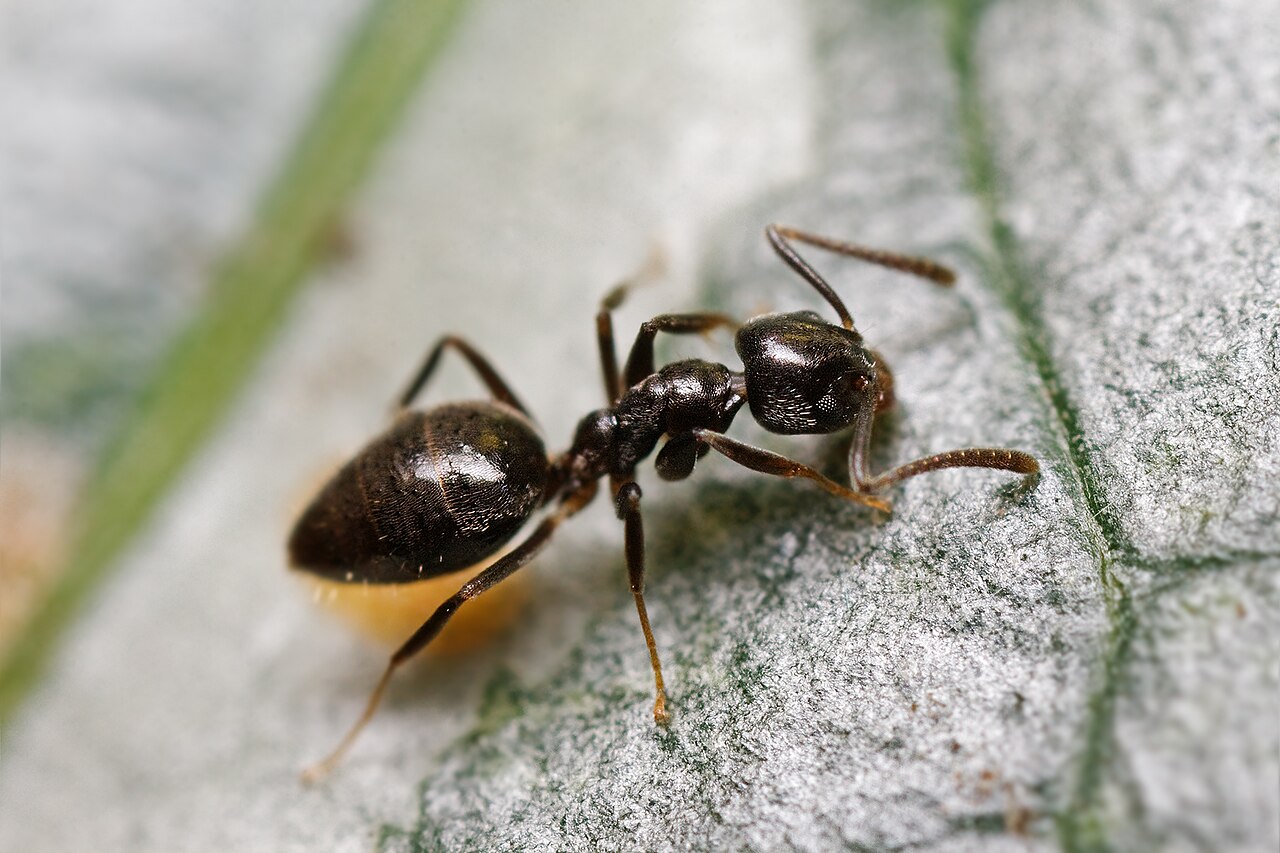
Ants are easy to recognize as a group and harder to name as a species. Every ant has elbowed antennae, a pinched waist with one or two raised nodes, and wingless workers. Species matters: a bait that empties a pavement ant colony in a week can be ignored by a colony feeding on something else.
The four we find most often indoors
- Odorous house ant (Tapinoma sessile) — an eighth of an inch, uniform dark brown to black, with a single flattened node hidden under the abdomen. Crushed workers smell sharply of rancid coconut. This is the ant trailing along a counter edge or out from under a dishwasher.
- Pavement ant (Tetramorium immigrans) — the same size, dark brown with paler legs, two waist nodes, and fine parallel grooves on the head and thorax. It nests under slabs and walkways and pushes fans of soil up through joints.
- Pharaoh ant (Monomorium pharaonis) — near a sixteenth of an inch, pale amber with a darker tip. It lives almost entirely indoors in heated wall voids, and it is the species where the wrong spray makes things measurably worse.
- Acrobat ant (Crematogaster species) — an eighth of an inch, light brown to nearly black, with a heart-shaped abdomen it raises over its back when disturbed. It nests in damp wood and foam sheathing, so it signals moisture as much as anything.
Winged ants appear when a colony is mature enough to send out reproductives. They are still ants: elbowed antennae, pinched waist, front wings longer than the hind pair. That separates them from termite swarmers, which have straight antennae, a straight-sided body and four wings of equal length.
How they get in
Ants need no damage to get inside. A worker takes the shortest path from nest to food or water, and the gaps it uses are already built into the house: the seam where a slab meets the sill plate, the space around a spigot, a weep hole in brick veneer, a cable sleeve through the wall.
Once a worker finds something worth carrying home it lays a chemical trail and recruits. That is why an ant problem seems to appear overnight — the scouting was invisible. Trails are the most useful evidence in the house, because a trail followed backwards ends at the entry point and often at the nest.
What draws them varies. Odorous house ants want sugars and aphid honeydew from landscape shrubs; pavement ants take grease and protein; pharaoh ants take almost anything, including soap film. Moisture is the constant: leaking traps, condensation on cold lines, a dishwasher seeping quietly for months.
Ants trailing indoors after heavy rain are usually a colony that was already tight against the foundation, flooded out and moving up. The nest rarely started inside.
What they do
Most ants in Delaware homes are a nuisance rather than a hazard. They do not bite in any way that matters, carry no disease of household consequence, and cause no structural damage. The honest description is contamination and persistence: a wiped trail returns to the same line within hours because the pheromone is still on the surface underneath.
Two exceptions. Pharaoh ants are a genuine concern in health care and food handling settings, and they respond to repellent sprays by budding — splitting one colony into several. Acrobat ants hollow out wood already softened by a leak, so finding them indoors usually means finding water damage.
The species that damages structural timber is the carpenter ant. If the ants are large, black and over a quarter inch, read the carpenter ant page instead.
When you see them in Delaware
Ant activity in Kent County tracks soil temperature more than air temperature. The first indoor trails usually show in March and April, as colonies that overwintered under slabs and mulch beds resume foraging. Pavement ant swarms follow, often on the first warm still day after a wet spell, emerging indoors through slab cracks and floor drains — unnerving, but not damaging.
Summer carries the heaviest trails, particularly in the new-build slab subdivisions around Middletown where soil sits tight against a shallow footing. Dry stretches in July and August drive ants indoors for water: sink rims, pet bowls, shower pans.
Activity tapers with the first cold nights and effectively stops after hard frost, usually somewhere in November. Pharaoh ants are the exception. They live inside heated structures year round, which is a useful diagnostic on its own — tiny pale ants in a Delaware kitchen in midwinter are rarely anything else.
Odorous house ants vs pavement ants
These two account for most indoor ant calls in the territory, they are close to the same size, and they get treated differently. Sorting them out takes seconds in good light.
- Waist — pavement ants have two visible nodes. Odorous house ants have one, flattened and hidden, so the waist looks smooth.
- Surface — pavement ants carry fine parallel grooves on head and thorax. Odorous house ants are smooth and slightly shiny.
- Smell — crush one. Odorous house ants smell strongly of rancid coconut. Pavement ants smell of little.
- Outdoor evidence — piles of fine soil at driveway and walkway joints mean pavement ants. Trails from a landscape bed or overhanging limb suggest odorous house ants.
The practical difference: pavement ant colonies are usually single and locatable, so treatment can be aimed at one nest. Odorous house ants form large networks with many queens and satellite nests, and a contact spray fragments such a colony rather than ending it. That is why we bait them and wait.
How to keep them out
Exclusion and sanitation will not clear an active infestation on their own, but they decide how fast it returns. Most of the work is outside.
- Seal penetrations: spigots, dryer vents, cable and line-set sleeves, gaps under door thresholds.
- Pull mulch and soil back from the foundation so there is a dry, visible band of masonry to inspect.
- Cut back shrubs and limbs touching siding or roofline. A branch on a gutter bridges everything sealed at ground level.
- Fix the water first: dripping hose bibs, gutters discharging at the foundation, condensation on crawlspace lines, a slow trap leak.
- Store sugar, cereal and pet food in containers with gasketed lids, and rinse recycling before it sits in the garage.
- Wipe trails with a detergent solution. The point is breaking the pheromone line, not killing the ants on it.
Homes on crawlspace foundations around Camden and Wyoming gain most from moisture work. A sound vapor barrier and dry piers remove the conditions acrobat ants need to settle.
How we treat ants
Treatment starts with inspection, not application. We follow trails to their entry points, check the usual harborage — under slabs, inside wall voids, behind insulation, in beds against the foundation — and identify the species from workers rather than from behavior.
From there the approach is integrated pest management: correct or flag the conditions supporting the colony, then place the smallest effective treatment where the ants are. For most indoor species that means non-repellent baits matched to what the colony is feeding on, set on active trails and left undisturbed so workers carry the material back to brood and queens. Baiting looks slow at first. It is the only method that reaches nests nobody can see.
Outdoors we treat the structural perimeter and located nests directly. Interior spraying stays limited on purpose — with odorous house ants and pharaoh ants it causes budding.
Then we monitor. Follow-up visits confirm trails are gone rather than relocated and recheck the entry points found on the first inspection. Where pressure is chronic, as in older brick housing around Dover and Odessa, a scheduled general pest control program works better than repeated one-off treatments. If you are unsure what you have, send a photo through our contact page.
Ants FAQs
What are the tiny black ants in my kitchen?
In Delaware they are usually odorous house ants or pavement ants, both around an eighth of an inch. Crush one: odorous house ants give off a strong rancid coconut smell, pavement ants do not. Pharaoh ants are a third possibility but are noticeably smaller and pale amber rather than black.
Why do ants keep coming back after I spray?
Contact sprays kill the workers you can see, which is a small fraction of the colony. With odorous house ants and pharaoh ants, repellent sprays can also split the colony into satellite nests, so the trails return in more places than before. Baiting reaches the queens and brood, which is what actually ends the colony.
Do ants in the house mean the house is dirty?
No. Ants forage wherever a trail leads, and clean homes get them regularly. Moisture, an unsealed entry point and an outdoor colony against the foundation matter far more than housekeeping.
Why do I get ants indoors after heavy rain?
Colonies nesting under slabs, mulch and shallow soil get flooded and move to drier ground, which often means up into a wall void or slab crack. It is usually a colony that was already at the structure rather than a new one. Activity often settles once the ground dries.
Are the winged ants in my basement termites?
Check the antennae and wings. Ants have elbowed antennae, a pinched waist and front wings longer than the hind wings; termite swarmers have straight antennae, a straight-sided body and four wings of equal length. Pavement ants commonly swarm indoors in spring through floor cracks and drains.
How long does ant treatment take to work?
Bait-based treatment usually shows a clear drop in trailing within a few days to two weeks, depending on colony size and how many satellite nests are involved. Activity can briefly increase at first as workers recruit to the bait, which is normal. Follow-up visits confirm whether trails are gone or simply moved.
Do household ants bite or sting?
The common indoor species in Delaware do not sting and rarely bite in a way anyone notices. They are a contamination and nuisance issue rather than a health one. Acrobat ants can pinch if handled, but it is minor.
Where we treat
Ants control across Delaware
- Claymont, DE
- Hockessin, DE
- Wilmington, DE
- Newark, DE
- New Castle, DE
- Bear, DE
- Delaware City, DE
- Odessa, DE
- Middletown, DE
- Townsend, DE
- Smyrna, DE
- Clayton, DE
- Kenton, DE
- Cheswold, DE
- Hartly, DE
- Little Creek, DE
- Dover, DE
- Wyoming, DE
- Camden, DE
- Marydel, DE
- Magnolia, DE
- Viola, DE
- Frederica, DE
- Felton, DE
- Harrington, DE
- Milford, DE
- Houston, DE
- Lincoln, DE
- Greenwood, DE
- Ellendale, DE
- Bridgeville, DE
- Seaford, DE
- Bethel, DE
- Laurel, DE
- Delmar, DE
Get on the schedule
Dealing with ants?
Send a photo and a few details. Correct identification is free and it changes the treatment.