

Pest library · Araneae
Spider Control in Delaware
Delaware houses hold a short list of common spiders, and almost all of them are harmless predators. Knowing which ones you actually have makes the problem smaller than it looks.
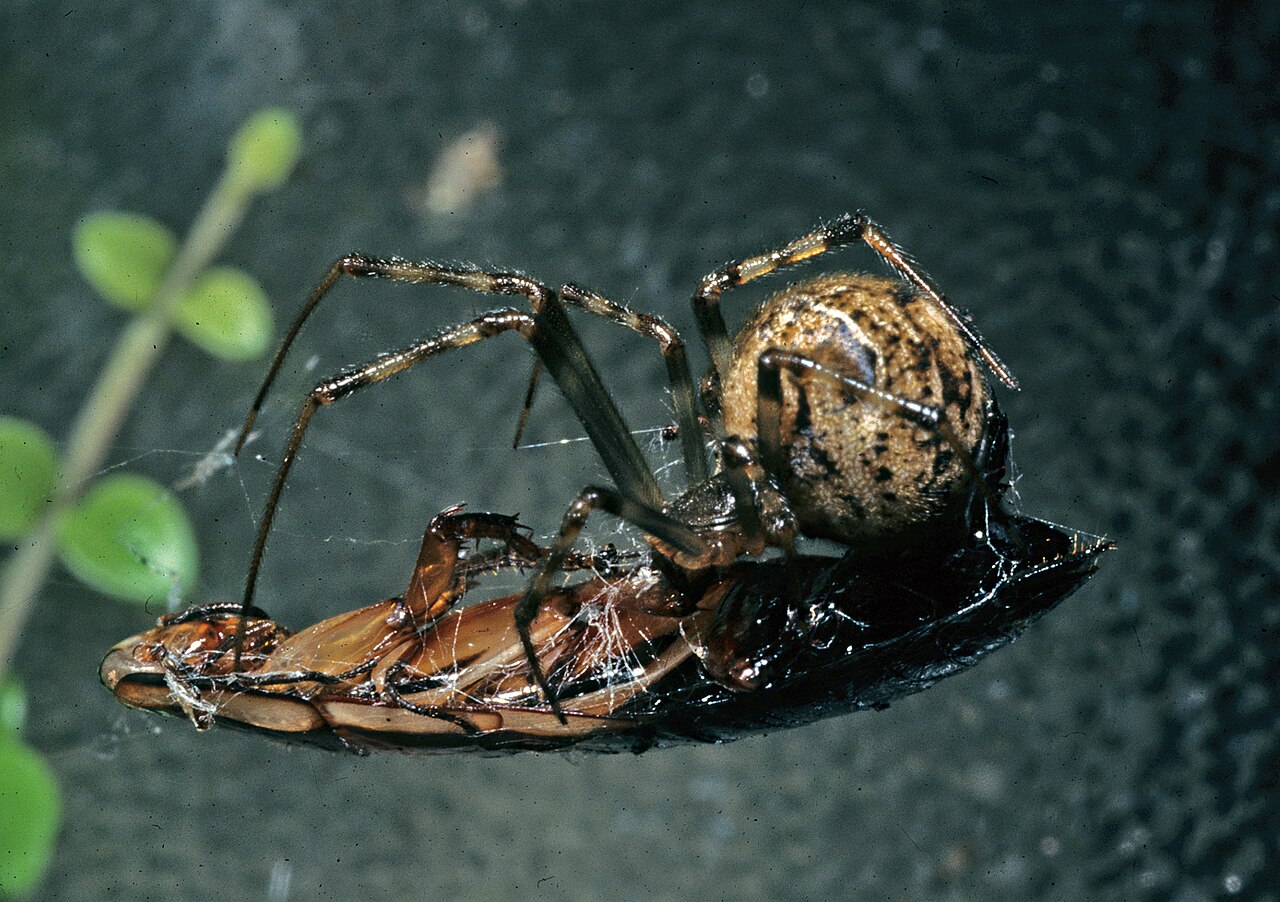
What common Delaware spiders look like
Spider is a broad label. Delaware holds hundreds of species, and only a handful turn up indoors with any regularity. Knowing the five or six that share our houses is more useful than keying out every spider in the yard.
Cellar spiders
Pale, spindly and long-legged, strung up in basement corners, crawlspace joists and garage ceilings. The body is about a quarter inch and the legs run several times that. In the crawlspace foundations around Camden and Wyoming they are close to universal, and a heavy population is telling you about moisture rather than about spiders.
Common house spider
Parasteatoda tepidariorum is a small tan to dull brown cobweb spider with a high rounded abdomen and faint chevron markings. It hangs upside down in a tangled web in window frames, ceiling corners and under deck rails, and accounts for most of the abandoned cobwebs people sweep down in spring.
Wolf spiders
These generate the calls. Large, hairy, gray-brown, fast, built for running rather than web building, with the biggest reaching an inch and a half across the legs. They hunt at ground level and wander in through door sweeps and slab expansion joints. Females carry an egg sac at the spinnerets and later a mat of spiderlings on the back.
Orb weavers and yellow sac spiders
Orb weavers build the wheel webs that appear across porch lights and shrubs from late summer. They are outdoor spiders and rarely establish inside. Yellow sac spiders are small, pale yellow to greenish and nocturnal, leaving flat silk retreats where wall meets ceiling. They cause most of the genuine, minor spider bites here.
How they get in
Spiders do not seek shelter the way a mouse does. They follow food and they follow gaps. A lit house on a warm evening near the Delaware Bay marshes is an insect magnet before it is a spider problem.
They arrive three ways: walking in at ground level, riding in on stored items, or hatching inside from an egg sac in an undisturbed corner. The last is why a basement keeps producing spiders after you think you cleared it.
- Gaps under garage and entry doors where an old sweep has compressed
- Slab expansion joints and unsealed sill plates in newer Middletown-area subdivisions
- Crawlspace vents and access hatches with broken screening
- Weep holes and mortar cracks in older brick around Odessa and Dover
- Firewood, cardboard, potted plants and stored boxes brought in from a shed
- Torn window screens and open utility penetrations behind the meter or hose bib
Exterior lighting is the underrated factor. White porch and floodlights draw crickets, moths, stink bugs and midges to the wall, and spiders build where the food is. Warm-toned lamps, or a fixture moved away from the door, thin porch webbing faster than any spray.
What they do
For the most part, nothing you would object to. Spiders are predators that eat the insects already in and around your home. They do not damage structures, chew wiring, contaminate food or transmit disease. The real complaints are cosmetic: webbing across soffits and porch ceilings, egg sacs in window channels, and the startle of a wolf spider crossing a floor at night. Worth handling, but not a health emergency.
Bites are uncommon and usually happen when a spider is pressed against skin inside clothing, bedding or a boot. Most house spiders cannot meaningfully break human skin, and a yellow sac spider bite leaves a sore red welt that resolves on its own. Any wound that spreads, ulcerates or comes with fever deserves medical attention regardless of cause.
Black widow does occur in Delaware, but it is uncommon and reclusive. Expect it in undisturbed outdoor spots: under stacked lumber, in meter boxes, in rarely used sheds. Look before reaching into those places and the risk stays close to zero.
When you see them in Delaware
Spiders are present year round, but the calls come in waves. Egg sacs laid the previous fall hatch through late spring, which is why small spiders appear everywhere at once in May and June.
The heavy season is late August through October. Spiders that spent the summer growing are now full size, orb weaver webs appear overnight across porches and shrub lines, and adult male wolf spiders and grass spiders begin wandering for mates. That wandering is what puts them across your kitchen floor, and it lines up with the fall movement of every other insect ahead of the first hard frost in November.
Winter thins the outdoor population but not the indoor one. Cellar spiders in a heated basement or damp crawlspace carry on through January, so a February inspection often turns up more webbing below the house than above it.
Spiders people think are brown recluses
This is the most common spider misidentification in the state, and it is worth correcting plainly: Delaware has no established brown recluse population. Loxosceles reclusa has a well-defined native range centered on the lower Midwest and mid-South, and Delaware sits well outside it. Isolated specimens have traveled here in freight, but they do not form populations. What people are almost always looking at instead:
- Cellar spiders — tiny pale body, absurdly long legs
- Common house spider — tan, rounded abdomen, tangled web
- Wolf spiders — large, hairy, brown, ground-running, the most frequent mistaken report
- Grass and funnel weavers — brown with lengthwise stripes, fast, everywhere in fall
- Yellow sac spiders — small, pale, nocturnal, and the actual cause of most bites blamed on recluses
If you want to check anyway, the violin marking is the least reliable feature; plenty of unrelated brown spiders carry a dark patch that reads as a violin in a phone photo. The dependable marks are three: six eyes in three pairs instead of the usual eight, legs uniformly tan with no bands or thick spines, and a flat even light brown body with no mottling. Almost every spider photographed as a recluse here fails at least two of those tests.
Slow-healing skin lesions get diagnosed as recluse bites constantly in states where the spider does not live. Bacterial infection is a far more likely explanation here, so treat a spreading or ulcerating wound as a medical question rather than a spider question.
How to keep them out
Spider control is mostly insect control and gap control. Reduce the food, close the routes, and the population follows.
- Fit and maintain door sweeps; a quarter-inch gap is an open door to a wolf spider
- Seal utility penetrations, sill plate gaps and foundation cracks with sealant or copper mesh
- Screen crawlspace and gable vents, and keep the crawlspace hatch tight
- Cut shrubs, ivy and mulch back off the siding and keep a bare strip along the foundation
- Move firewood, stacked lumber and stored pots off the wall and up off the ground
- Switch exterior fixtures to warm or amber lamps, or relocate them away from doors
- Manage crawlspace and basement moisture with grading, gutters and downspout extensions
- Vacuum webbing and egg sacs regularly; removing the next generation physically is something no residual product does as directly
How we treat spiders
We start with an inspection rather than a sprayer. Where the webbing is, which species built it, what insect source feeds the population, and what the moisture picture looks like below the house all change the response. A cellar spider problem and a wolf spider problem have different fixes.
Treatment is integrated pest management, not a blanket application: physical removal of webs and egg sacs from eaves, soffits and window frames, targeted application at harborage and entry points rather than broadcast spraying across living space, and dealing with the prey insects driving the population.
We also flag the conditions that decide whether spiders return: a failed door sweep, an open crawlspace vent, a floodlight gathering insects at the front door. Follow-up is scheduled around the season, with spring visits aimed at hatching egg sacs and fall visits at wandering adults. Spiders are handled inside general pest control, since the same work suppresses the insects they hunt. If you are unsure what you have, a clear photo helps, so get in touch and we can usually identify it first.
Spiders FAQs
Are there brown recluse spiders in Delaware?
No. Delaware has no established brown recluse population, and the species' native range is centered on the lower Midwest and mid-South. Isolated specimens have arrived in freight over the years, but they do not form populations here. A brown spider in a Delaware basement is almost always a wolf spider, grass spider or common house spider.
Are house spiders in Delaware dangerous?
Almost none of them are. Cellar spiders, common house spiders, orb weavers and wolf spiders are harmless to people and cannot deliver a medically significant bite. Yellow sac spiders can cause a sore red welt that heals on its own. Black widow is the only Delaware spider of real concern and it is uncommon and reclusive.
Do black widow spiders live in Delaware?
Yes, but they are uncommon and rarely found in living space. They prefer undisturbed sheltered spots outdoors such as woodpiles, meter boxes, sheds and crawlspace clutter. Wearing gloves and looking before you reach into those areas is enough precaution for most homes.
Why do I suddenly have spiders in September?
Late summer and fall are when spiders reach full adult size and males begin wandering to find mates. Orb weaver webs also appear across porches and shrubs at the same time. The insects spiders feed on are moving as well, ahead of the first hard frost in November.
Does killing spiders get rid of them?
Only briefly, if the food source is still there. Spiders move into a house because insects are available around it, so reducing exterior lighting, sealing gaps and controlling the prey insects does far more than killing individual spiders. Vacuuming webs and egg sacs also removes the next generation.
Do spiders mean my house is dirty?
No. Spiders are drawn to insects and to undisturbed spaces, not to food debris or poor housekeeping. Basements, garages, crawlspaces and soffits attract them because they are quiet and dark, not because they are unclean. Moisture in a crawlspace is a more useful thing to check.
What should I do about a spider bite?
Wash the area, use a cold compress and watch it. Most bites attributed to spiders are something else entirely, and genuine house spider bites resolve without treatment. If the wound spreads, ulcerates or comes with fever or muscle cramps, see a medical provider rather than trying to identify the spider.
Where we treat
Spiders control across Delaware
- Claymont, DE
- Hockessin, DE
- Wilmington, DE
- Newark, DE
- New Castle, DE
- Bear, DE
- Delaware City, DE
- Odessa, DE
- Middletown, DE
- Townsend, DE
- Smyrna, DE
- Clayton, DE
- Kenton, DE
- Cheswold, DE
- Hartly, DE
- Little Creek, DE
- Dover, DE
- Wyoming, DE
- Camden, DE
- Marydel, DE
- Magnolia, DE
- Viola, DE
- Frederica, DE
- Felton, DE
- Harrington, DE
- Milford, DE
- Houston, DE
- Lincoln, DE
- Greenwood, DE
- Ellendale, DE
- Bridgeville, DE
- Seaford, DE
- Bethel, DE
- Laurel, DE
- Delmar, DE
Get on the schedule
Dealing with spiders?
Send a photo and a few details. Correct identification is free and it changes the treatment.